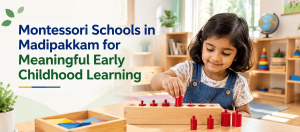
Choosing the right preschool is one of the first important decisions parents make for their children. Early education can influence a child’s confidence, communication, independence, concentration, and attitude toward learning. Best Montessori Schools in Chennai generally focus on creating child-friendly environments where young learners can develop through practical activities, hands-on experiences, and guided learning. For families in Madipakkam, understanding the Montessori approach can help them identify an early education environment that suits their child’s needs.
What Is Montessori Education?
Montessori education is a child-centred approach to early learning developed around the idea that children learn naturally when they have access to suitable materials, meaningful activities, and supportive guidance.
Instead of depending mainly on memorisation and worksheets, Montessori classrooms encourage children to learn through observation, movement, touch, repetition, and practical experiences. Children are given opportunities to work independently while teachers guide them according to their individual readiness.
A Montessori classroom may include areas dedicated to Practical Life, Sensorial learning, Language, Mathematics, Culture, and other age-appropriate activities. Each area contributes to different aspects of a child’s development.
Why Choose Montessori Early Education?
The early years are a time when children develop many basic skills that influence their future learning. A well-planned Montessori environment can give children opportunities to practise these skills naturally.
One of the key features of Montessori education is learning at an appropriate pace. Children are not expected to master every activity at the same time. Teachers observe their progress and introduce new challenges when they are ready.
This can make learning feel less stressful and more engaging. Children can repeat activities, correct mistakes, and gradually become more comfortable with new concepts.
A Prepared Environment for Young Learners
A Montessori classroom is carefully arranged with children in mind. Learning materials are usually placed where children can access them easily, and the classroom encourages order and independence.
For example, a child may choose a puzzle from a shelf, carry it to a work area, complete it, and return it to its original place. Through this simple routine, the child practises decision-making, coordination, concentration, and responsibility.
The prepared environment also gives children opportunities to work without unnecessary interruptions. This can help them develop longer periods of attention as they become familiar with different activities.
Learning Through Hands-On Activities
Young children learn effectively when they can interact with what they are learning. Montessori materials allow them to touch, move, sort, match, count, compare, and arrange objects.
This hands-on method is useful for early childhood education because children can connect ideas with real experiences. Rather than simply hearing about size, shape, quantity, or sequence, they can work with materials that demonstrate these concepts.
Developing Independence and Confidence
Independence is an important part of Montessori learning. Children are encouraged to complete suitable tasks by themselves instead of depending on adults for every small step.
Practical Life activities are particularly useful in this area. Children may practise pouring, transferring objects, folding, arranging, cleaning, dressing, or caring for plants.
These activities support more than practical skills. They can also strengthen hand-eye coordination, concentration, movement, and confidence.
When a child successfully completes an activity after several attempts, the experience can create a sense of achievement. Small successes can encourage children to approach future challenges with greater confidence.
Supporting Early Language and Literacy
Language development is a major part of preschool education. Montessori classrooms may use stories, songs, picture cards, phonics activities, sound games, vocabulary exercises, and early writing materials to support communication and literacy.
Children can gradually learn to recognise sounds and connect them with letters. They may also practise vocabulary by identifying familiar objects and describing what they see.
Reading aloud at school and at home can further support language development. Parents can ask simple questions about stories, encourage children to describe pictures, and give them plenty of opportunities to express their thoughts.
These everyday conversations can make language learning more natural and enjoyable.
Building Early Mathematical Skills
Montessori mathematics introduces children to numbers through concrete experiences. Children can count objects, match quantities, recognise number sequences, identify patterns, and work with materials that represent mathematical relationships.
This approach can help make early maths less intimidating. Instead of immediately expecting children to memorise equations, teachers can allow them to understand quantity and relationships through physical materials.
As children become comfortable with these concepts, they can gradually move toward more abstract mathematical thinking.
The Role of Montessori Teachers
Teachers play a central role in creating a successful Montessori learning environment. Rather than simply giving instructions to the entire class, Montessori educators observe children and provide individual guidance.
A teacher may demonstrate how to use a material and then allow the child to practise independently. Observation helps the teacher understand when a child is ready for a new activity or needs additional support.
Parents considering a Montessori preschool can ask about teacher training, classroom experience, teacher-child interaction, and how individual learning needs are addressed.
A calm and respectful relationship between teachers and children can make a significant difference to the overall preschool experience.
What Parents Should Consider When Choosing a Montessori School
Finding a suitable Montessori school involves looking beyond the classroom appearance. Parents can consider several practical factors before making a decision.
Visit the Learning Environment
A school visit can provide useful information about classroom organisation, learning materials, cleanliness, safety, and children’s engagement.
Ask About the Daily Routine
Parents can ask how much time children spend on individual activities, group sessions, outdoor play, practical activities, language learning, and creative work.
Understand the Teaching Approach
It is helpful to understand whether children receive opportunities for independent learning and whether teachers provide age-appropriate guidance rather than relying mainly on memorisation.
Consider Parent-School Communication
Regular communication helps parents understand their child’s classroom experience and progress. Ask how teachers share observations and how parents can communicate questions or concerns.
Montessori Learning Beyond the Classroom
The Montessori approach can also inspire simple activities at home. Parents can encourage children to organise their toys, put away books, water plants, help with simple household tasks, or choose between appropriate options.
Reading together, visiting parks, observing nature, drawing, building with blocks, and talking about everyday experiences can also support children’s curiosity.
The aim is not to turn every activity into a formal lesson. Children benefit from having time to play, observe, make choices, ask questions, and participate in everyday life.
Supporting a Strong Foundation for the Future
Quality early education should support the whole child rather than focusing only on academic skills. Children need opportunities to develop communication, independence, social awareness, concentration, coordination, creativity, and confidence.
Parents researching Montessori Schools in Madipakkam can compare schools based on their classroom environment, teaching approach, Montessori materials, teacher qualifications, daily routines, and communication with families. A school visit can also help parents understand whether the environment feels suitable for their child.
Montessori education can provide a thoughtful foundation by allowing children to learn through real experiences while receiving guidance from trained educators. With supportive teachers, an engaging environment, and active family involvement, early learning can become a positive experience that encourages children to remain curious, capable, and confident as they grow.